SEO vs Google Ads – Which is Better for Your Business?
Confused between SEO and Google Ads? Our comprehensive guide compares costs, timelines, ROI, and helps you choose the right strategy for your business growth.
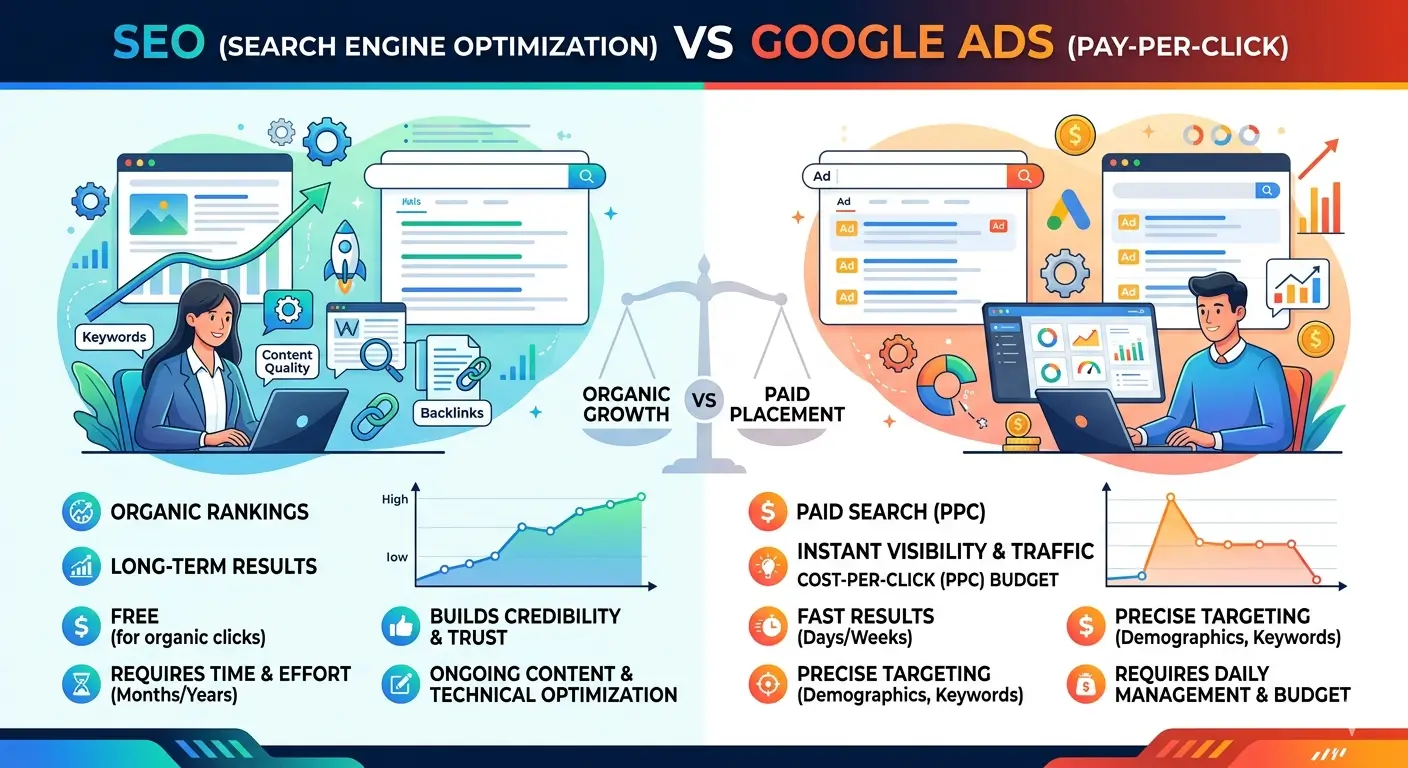

Image: Understanding the difference between organic search results and paid advertisements on Google.
Introduction
When it comes to digital marketing, two strategies dominate the conversation: Search Engine Optimization (SEO) and Google Ads (Pay-Per-Click Advertising) .
Both aim to drive traffic to your website and generate leads or sales. But the big question every business owner asks is: Which one is right for my business?
Should you invest in organic growth through SEO, or should you pay for instant visibility with Google Ads? The answer depends on your business goals, budget, timeline, and industry.
In this comprehensive guide, we'll break down the pros and cons, costs, timeframes, and ideal use cases for both SEO and Google Ads – so you can make an informed decision that maximizes your return on investment.
What is SEO? Understanding Organic Search

SEO (Search Engine Optimization) is the process of optimizing your website to rank higher in organic (non-paid) search results on Google. When someone searches for a keyword related to your business, SEO helps your website appear on the first page – without paying for each click.
How SEO Works:
SEO involves multiple interconnected strategies:
- Keyword Research: Identifying what your potential customers are searching for
- On-Page Optimization: Optimizing content, meta tags, headings, and images
- Technical SEO: Improving site speed, mobile-friendliness, and crawlability
- Content Creation: Publishing valuable, relevant content regularly
- Link Building: Getting quality websites to link back to your content
- User Experience: Making your website easy to navigate and engaging
✅ Advantages of SEO
| Factor | Details |
|---|---|
| Cost | Free traffic (no cost per click) – you invest time and effort, not advertising dollars |
| Long-Term Results | Once you rank, you can get consistent traffic for months or years |
| Credibility & Trust | Users trust organic results more than ads – studies show 70-80% of users skip paid ads |
| Click-Through Rate (CTR) | Organic results typically get 10x higher CTR than paid ads |
| ROI | Excellent long-term return on investment – the traffic keeps coming without ongoing costs |
| Brand Authority | High rankings establish you as an industry leader |
❌ Disadvantages of SEO
- Time-Consuming: It takes 3-6 months (or longer) to see significant results
- Ongoing Effort: Requires regular content creation, backlinks, and updates
- Algorithm Dependency: Google algorithm updates can impact rankings unexpectedly
- Uncertainty: No guarantee of ranking despite best efforts
- Competition: Competitive industries require significant resources to outrank established players
What is Google Ads? Understanding Paid Search

Google Ads (formerly Google AdWords) is a pay-per-click (PPC) advertising platform where you bid on keywords to have your ads appear at the top of Google search results. You pay only when someone clicks on your ad.
How Google Ads Works:
- Keyword Bidding: You bid on specific keywords relevant to your business
- Ad Creation: Write compelling ad copy that encourages clicks
- Targeting: Choose who sees your ads based on location, device, time, demographics
- Budget Control: Set daily budgets and maximum cost-per-click
- Performance Tracking: Measure every click, conversion, and dollar spent
- Optimization: Continuously refine campaigns for better results
✅ Advantages of Google Ads
| Factor | Details |
|---|---|
| Speed | Instant visibility – your ad can appear within hours of setup |
| Targeting Options | Hyper-specific targeting by location, device, time, demographics, interests, and more |
| Budget Control | Set any daily budget (as low as ₹300/day) and pause anytime |
| Measurable ROI | Track every click, conversion, and dollar spent with precision |
| Brand Awareness | Your brand appears at the very top of search results, building recognition |
| Testing Capability | Test market demand, messaging, and offers quickly |
| Seasonal Flexibility | Scale up during peak seasons, scale down during slow periods |
❌ Disadvantages of Google Ads
- Cost: You pay for every click – competitive keywords can cost ₹200-₹1000+ per click
- Short-Term: Traffic stops the moment you pause your campaign – no residual benefit
- Ad Blindness: Many users consciously skip ads (studies show 70-80% ignore paid results)
- Click Fraud: Competitors or bots can click your ads, wasting budget
- Requires Expertise: Poorly managed campaigns waste money quickly
- Diminishing Returns: As competition increases, costs rise and ROI decreases
SEO vs Google Ads: Head-to-Head Comparison
| Parameter | SEO | Google Ads |
|---|---|---|
| Time to Results | 3-6+ months (slow build) | Instant (within hours) |
| Cost Structure | Free traffic (requires time/effort) | Pay per click (PPC) – ongoing cost |
| Longevity | Long-term (months/years of traffic) | Short-term (only while paying) |
| Trust Factor | High (users trust organic results) | Medium (ads are often ignored) |
| Click-Through Rate | 20-30% for top positions | 2-5% average for top positions |
| Control | Limited (Google decides rankings) | Full control over ads, budget, targeting |
| Scalability | Slow but sustainable growth | Fast but expensive scaling |
| ROI Trajectory | Improves over time (compounds) | Requires continuous investment |
| Best For | Building sustainable traffic, brand authority | Quick wins, promotions, testing, seasonal campaigns |
| Risk | Algorithm changes, competitor actions | Budget waste, click fraud, ad fatigue |
Visual Guide: When to Choose Each Strategy
Choose SEO When:

✅ You have time to wait for results (3-6 months minimum)
✅ You're thinking long-term (building a sustainable digital asset)
✅ You have a limited ongoing budget for paid advertising
✅ You want to build trust and authority in your industry
✅ Your business has high-volume search terms with commercial intent
✅ You're already investing in content marketing
✅ You want passive traffic that keeps coming without ongoing payments
✅ Your industry has good profit margins that justify long-term investment
Perfect for: Local businesses, service providers, content websites, blogs, e-commerce stores building long-term authority.
Choose Google Ads When:

✅ You need immediate results (today or this week)
✅ You're launching a new product or service and need quick validation
✅ You're running a seasonal promotion (Diwali, Christmas, summer sales)
✅ You have budget allocated for marketing and can sustain ongoing spend
✅ You want to test market demand quickly before committing to SEO
✅ You need to outrank competitors temporarily for key terms
✅ Your industry is highly competitive and SEO will take too long
✅ You have time-sensitive offers that expire soon
✅ You want precise targeting by location, device, or demographics
Perfect for: E-commerce stores during sales, new business launches, event promotions, urgent services (plumbers, electricians), testing new markets.
The Smart Strategy: Combine Both for Maximum Results

Most successful businesses don't choose between SEO and Google Ads – they use both in a balanced, integrated strategy. Here's how to create a powerful hybrid approach:
The Hybrid Strategy Framework
| Business Stage | Recommended Approach |
|---|---|
| Months 1-3 (Launch) | Google Ads for immediate traffic + Begin SEO foundation work |
| Months 4-6 (Growth) | Continue Google Ads + Ramp up SEO content creation |
| Months 7-12 (Scale) | SEO starts delivering; optimize ad spend for high-value terms |
| Year 2+ (Maturity) | SEO handles core traffic; ads for seasonal peaks and new offers |
Strategic Integration Tips:
- Use Google Ads to validate keywords before investing in SEO content
- Target high-commercial-intent keywords with ads while building organic rankings
- Use SEO for informational content (blogs, guides) and ads for transactional queries
- Retarget website visitors from organic traffic with display ads
- Use ad data to inform SEO strategy – which keywords convert best?
- Protect your brand – bid on your brand name to prevent competitors from stealing traffic
- Fill seasonal gaps – when SEO traffic dips seasonally, increase ad spend
Real-World Example: Dreams4u's Recommended Approach

Let's see how a digital marketing agency (like Dreams4u) would implement both strategies:
Google Ads Strategy:
- Target high-intent keywords like "best digital marketing agency near me" or "SEO services pricing"
- Run remarketing campaigns for visitors who don't convert immediately
- Create seasonal campaigns for Diwali, New Year, and other peak business periods
- Test new service offerings quickly before building SEO content
SEO Strategy:
- Create comprehensive guides like this one (SEO vs Google Ads)
- Write case studies showing client success stories
- Build location pages for "digital marketing in [city]" searches
- Develop pillar content around core topics (SEO, PPC, content marketing)
- Earn backlinks from industry publications and business blogs
Results:
- Immediate: Inquiries from Google Ads while SEO builds
- Short-term (3-6 months): Growing organic traffic for informational queries
- Long-term (6-12 months): Consistent organic leads + optimized ad spend
- Year 2+: Sustainable traffic with ads as strategic supplement
Cost Comparison: What Should You Budget?

SEO Investment (Typical Ranges)
| Business Size | Monthly Investment | Timeline for Results |
|---|---|---|
| Small/Local | ₹15,000 - ₹30,000 | 4-6 months |
| Medium Business | ₹30,000 - ₹75,000 | 3-5 months |
| Enterprise | ₹75,000 - ₹2,00,000+ | 2-4 months |
Note: SEO is an investment in creating assets that continue delivering traffic long after the work is done.
Google Ads Investment (Typical Ranges)
| Business Size | Monthly Budget (Ad Spend + Management) | Timeline for Results |
|---|---|---|
| Small/Local | ₹15,000 - ₹30,000 (includes ad spend) | Immediate (day 1) |
| Medium Business | ₹50,000 - ₹1,50,000 (ad spend + 10-15% management) | Immediate |
| Enterprise | ₹2,00,000 - ₹10,00,000+ | Immediate |
Note: Google Ads requires ongoing budget – traffic stops when payments stop.
ROI Comparison Over 12 Months
| Time Period | SEO ROI | Google Ads ROI |
|---|---|---|
| Month 1-3 | Negative (investment phase) | Positive (if campaigns optimized) |
| Month 4-6 | Breaking even | Positive |
| Month 7-9 | Positive | Positive |
| Month 10-12 | Strong positive | Positive (requires continued spend) |
| Year 2+ | Excellent (compounding) | Requires ongoing budget |
Decision Matrix: Choose Your Path

Use this simple decision matrix to guide your choice:
| Your Situation | Primary Recommendation | Secondary Strategy |
|---|---|---|
| New business, limited budget | SEO (long-term focus) | Micro-budget Google Ads for testing |
| New business, has budget | Google Ads (immediate) + SEO (long-term) | - |
| Established business, steady traffic | Maintain SEO + Strategic Google Ads | Test new keywords with ads |
| Need sales this week | Google Ads | - |
| Building a brand | SEO (content + authority) | Brand awareness ads |
| Seasonal business | Google Ads during peak + SEO year-round | - |
| Highly competitive industry | Both – SEO for sustainability, ads for quick wins | Focus on long-tail keywords for SEO |
| Local business | Local SEO + Google Ads for "near me" searches | - |
| E-commerce store | Product SEO + Google Shopping Ads | Remarketing campaigns |
| B2B services | SEO (educational content) + LinkedIn Ads | - |
Common Myths Debunked

Myth 1: "SEO is free"
Fact: SEO requires significant time investment (which is money) or agency fees. It's "free traffic" after investment, not free to achieve.
Myth 2: "Google Ads is too expensive"
Fact: With proper targeting and optimization, Google Ads can deliver positive ROI even on small budgets. Start small, test, and scale what works.
Myth 3: "You only need one or the other"
Fact: Most successful businesses use both strategically. They complement each other perfectly.
Myth 4: "SEO is dead"
Fact: SEO evolves but remains crucial. Google processes over 8.5 billion searches daily – organic results still get the majority of clicks.
Myth 5: "Google Ads gives instant success"
Fact: While ads start immediately, achieving profitable campaigns requires testing, optimization, and expertise. Many campaigns lose money initially.
Myth 6: "You can't compete with big brands"
Fact: Long-tail keywords, local SEO, and niche targeting level the playing field. Small businesses can win in specific areas.
Getting Started: Your 30-Day Action Plan

Week 1: Research & Planning
- Identify your top 20-30 business keywords
- Research competition for these terms (both organic and paid)
- Set a realistic budget for your chosen strategy
- Define clear goals and KPIs (leads, sales, traffic targets)
Week 2: Foundation
- Ensure your website is optimized for conversions
- Set up Google Analytics and Google Search Console
- Create high-quality content for your key service pages
- If using Google Ads, set up conversion tracking
Week 3: Implementation
- For SEO: Conduct technical audit, optimize key pages, create content calendar
- For Google Ads: Create campaign structure, write ad copy, set up targeting
- For both: Ensure tracking is working correctly
Week 4: Launch & Monitor
- Launch your campaigns (SEO work begins, ads go live)
- Monitor initial results closely
- Make data-driven adjustments
- Document learnings for future optimization
Conclusion: Making the Right Choice for Your Business
There is no single "best" option between SEO and Google Ads. Both are powerful when used correctly – they simply serve different purposes and work best at different stages of your business journey.
Remember:
🔹 SEO is your long-term investment in sustainable growth – like buying a house that appreciates over time
🔹 Google Ads is your short-term solution for immediate results – like renting flexibility with instant access
🔹 The smartest businesses use both – owning the asset (SEO) while leveraging rentals (ads) for strategic advantages
The right strategy depends on your unique:
- Business goals (quick sales vs long-term brand building)
- Budget (how much you can invest monthly)
- Timeline (how soon you need results)
- Industry (competition level and search behavior)
- Team capacity (who will execute and manage)
Final Thought:
Start where you are with what you have. If you have time but limited budget, begin with SEO. If you need customers today and have budget, launch Google Ads. The perfect strategy is the one you'll execute consistently.
And when you're ready to build a comprehensive approach, consider how both strategies can work together to create a digital marketing engine that delivers both immediate wins and lasting success.
Frequently Asked Questions

Q1. Which is cheaper – SEO or Google Ads?
A: SEO is more cost-effective in the long run as it generates free traffic after initial investment. Google Ads requires ongoing budget but delivers immediate, controllable results. Think of SEO as buying vs. Google Ads as renting.
Q2. Can I do only SEO for my business?
A: Yes, if you have time to wait (6-12 months) and are focused on long-term growth. Many businesses successfully grow with SEO alone, especially in less competitive niches.
Q3. Is Google Ads suitable for small businesses?
A: Absolutely! Google Ads works with any budget. Start with as little as ₹300-500 per day, test what works, and scale successful campaigns. The key is proper targeting and optimization.
Q4. How long before I see results from SEO?
A: Typically 3-6 months for initial results, 6-12 months for significant traffic, and 12-24 months for dominant positions in competitive spaces. Patience is essential.
Q5. How long before I see results from Google Ads?
A: Immediately – your ads can start showing within hours. However, achieving profitable campaigns usually takes 2-4 weeks of testing and optimization.
Q6. Can I use both SEO and Google Ads together?
A: Yes – and this is actually the most effective approach. Use ads for immediate results and testing while building SEO for long-term sustainability. They complement each other perfectly.
Q7. What's the ideal budget split between SEO and Google Ads?
A: For most businesses starting out: 60-70% on the strategy that aligns with your primary goal, 30-40% on the secondary. Adjust based on what delivers better results for your specific business.
Q8. Does Dreams4u offer both services?
A: Yes! Dreams4u specializes in both SEO and Google Ads, along with Social Media Marketing, Content Writing, and Branding services. We help you create an integrated strategy that maximizes your ROI.
Ready to Grow Your Business Online?
At Dreams4u, we help businesses like yours succeed with both SEO and Google Ads. Whether you need:
- Organic traffic that keeps coming month after month
- Paid campaigns that deliver instant customers
- A hybrid strategy customized for your specific goals
- Expert guidance on where to invest your marketing budget
We have the expertise to create a data-driven marketing plan that delivers real ROI.
Get Your Free Consultation Today!
📞 Call us: 9717030244 🌐 Visit our website: dreams4u.in 📧 Email: Inquiry regarding SEO 📍 Serving clients across India and globally
Tags
Want Your Business to Rank on Google?
Get a free SEO audit and grow your traffic with Dreams4U.
Get Free SEO Audit